Visualizzazione post con etichetta indiani america. Mostra tutti i post

giovedì 1 settembre 2016

Frusta

Una frusta tradizionale finita ora dopo lungo tempo. Corno di cervo inciso e dipinto con ocra rossa, pelle a concia indiana, perlime veneziane, ermellino.
..........................
a traditional quirt finished just now after long time. Carved deer antler, red ocher, braintanned hide, old Italian beads.


sabato 22 settembre 2012

Trofei Umani - part 2

Scalpo steso su telaio - zona delle Pianure-
La mutilazione dei nemici morti è spesso menzionata nei resoconti storici e etnostorici dello stato di guerra delle pianure. L'usanza di scalpare era la più comune forma di mutilazione, sul cui significato si è molto scritto. Uno scalpo era riconosciuto semplicemente come un trofeo, "un emblema di vittoria" da riportare al villaggio per danzarlo e gioire ancora" (Grinnell)
Altre parti del corpo servivano al medesimo scopo. Al ritorno da una spedizione di guerra gli scalpi ed altre parti del corpo prese come trofei erano preparate dalle donne per i festeggiamenti della vittoria ottenuta. Presentandosene l'opportunità anche le donne rivestivano un ruolo attivo nella mutilazione dei nemici morti. Eastman descrive una donna Sioux che "tagliò le mani ed i piedi di un qualche piccolo bambino Chippewa. e iniziò a lavorarli e cucirli per un necklace".
Trofeo con perline, denti d'alce e metacarpi umani - Crow
"l'azione delle donne anziane di evirare il corpo morto dei nemici maschi è ben documentata negli scritti di altri attenti osservatori dello stato di guerra degli Indiani delle Pianure a partire dal 1790. Jean-Baptiste Truteau, un esperto commerciante Francese e attento osservatore delle tribù del Middle Missouri, ha descritto le furiose mutilazioni dei nemici morti da parte delle donne anziane: "Ho visto queste vecchie furie... tagliare via le mani e le parti virili dei nemici morti, mettersele attorno al collo o alle orecchie e danzare con esse davanti a tutti gli ingressi delle tende del villaggio" (Ewers 1997).
...Gli Assiniboine (Kennedy 1972), i Blackfeet (Ewers 1958), gli Cheyenne (Bourke 1892, Powell 1969), i Cree (Ewers 1958), i Crow (Ewers 1958; Denig 1930:491; Ruger 1888), i Pawnee (Grinnell 1923), i Sioux (Carrington 1896; Eastman 1849; Goodrich 1997; Marquis 1986) e gli Ute (Hamilton 1907) sono tutte tribù di cui sono stati riportati casi di taglio delle mani dei nemici durante le ostilità. 
Edward Denig, un commerciante nelle Pianure settentrionali durante la metà del 19° secolo, aveva molti buoni contatti con gli Indiani delle Pianure e scrisse sulla mutilazione di parti del corpo:
“ Non c’è alcun motivo religioso dietro il compimento di questi atti, e essi non sono fatti nella prospettiva di placare l’animo degli amici morti o come un sacrificio al Grande Mistero; niente nelle loro parole e azioni in queste situazioni fa pensare a qualcosa del genere; invece tutto ciò è solo insulto verso il nemico morto, e gloria selvaggia e vendetta per soddisfare se stessi”.
Nel Nord Ovest Lewis e Clark furono sorpresi nello scoprire l’uso del taglio della mano e del conservare le dita come trofei da parte di un gruppo Chinookan sul Columbia River, vicino Dalles. 
-------------------------------------
The mutilation of dead enemies is often mentioned in historical and ethnohistorian  stories about the Plains state of war. The practice of scalping was the most common form of mutilation, the meaning of which was written a lot about. A scalp was recognized simply as a trophy, "an emblem of victory" to return to the village to enjoy and dance it yet "(Grinnell)
Other body parts were used for the same purpose. Upon returning from a military expedition scalps and other body parts as trophies were taken by women and prepared for the celebration of the victory. Whenthere was the opportunity even the women played an active role in the mutilation of dead enemies. Eastman describes a Sioux woman who "cut off the hands and feet of some small child Chippewa children and began to work them and sew them to a necklace."
"The action of older women to emasculate the dead body of the enemy males is well documented in the writings of other keen observers of the state of war of the Plains Indians from 1790. Truteau Jean-Baptiste, a French merchant and expert observer of tribes of the Middle Missouri, described the furious mutilation of dead enemies by older women: "I saw these old mad ... cutting off hands and parts of dead enemies manly, to stretch herself around the neck or ears and dance with them in front of all the entrances to the tents of the village "(Ewers 1997).
The Assiniboine ... (Kennedy 1972), the Blackfeet (Ewers 1958), the Cheyenne (Bourke 1892, Powell 1969), the Cree (Ewers 1958), The Crow (Ewers 1958; Denig 1930:491; Ruger 1888), the Pawnee (Grinnell 1923), the Sioux (Carrington 1896, Eastman 1849, Goodrich 1997, Marquis 1986) and Ute (Hamilton 1907) are all tribes of which have been reported to cut the hands of the enemy during hostilities.
Edward Denig, a trader in the northern Plains during the mid-19th century, had many good contacts with the Plains Indians and wrote on the mutilation of body parts:
"There is no religious reason behind the performance of such acts, and they are not made with a view to appease the souls of dead friends or as a sacrifice to the Great Mystery, nothing in their words and actions in these situations suggests something like that, instead everything is just insult to the dead enemy, and wild glory and revenge to suit themselves. "
In the North West Lewis and Clark were surprised to discover the use of the cutting off of hands and keep your fingers as trophies by a group Chinookan on the Columbia River, near Dalles.

radiografia di un trofeo/necklace Apache


sabato 4 febbraio 2012

Alla moda Delle Pianure

Giacca appartenuta al capo Yellow Bull

Una serie di giacche in pelle provenienti da diverse tribù delle Pianure o dal Plateau.
----------------------------------------
A series of hide jackets from different tribes of the Plains or the Plateau.


domenica 22 gennaio 2012

Le Piume di Dio


Copricapo in piume d'aquila appartenuto a Yellow Calf -ora al British Museum
Una Leggenda Lumbee
"In principio, il Grande Spirito diede agli animali e agli uccelli la sapienza e il potere di parlare con gli uomini. Egli mandò queste creature all'uomo per mostrarsi attraverso di esse. Loro avrebbero insegnato ad un prescelto le canzoni e le danze sacre, così come tutti i riti e le tradizioni. La creatura più amata dal Grande Spirito era l'aquila, e attraverso essa Egli  raccontò la storia della vita. L'aquila, come sapete, ha solo due uova, e tutte le cose viventi del mondo sono divise in due. Uomo e donna, maschio e femmina e questo è vero per tutti gli animali, gli uccelli, gli alberi  i fiori e così via. Tutte le cose sono figlie di questi due principi in modo che la vita possa continuare. L'uomo ha due occhi, due mani, due piedi ed ha anche un corpo ed un anima, una sostanza ed un ombra.Attraverso i suoi occhi, vede scene piacevoli e spiacevoli, attraverso le sue narici gli odori buoni e cattivi, con le sue orecchie sente le notizie liete e le parole che lo rendono triste. La sua mente è divisa tra il bene e il male. La sua mano destra può essere usata per il male, per la guerra o per colpire una persona in collera. Ma la sua mano sinistra, che è vicino al suo cuore, è sempre piena di gentilezza. Il suo piede destro può condurlo in una strada sbagliata, ma il suo piede sinistro lo porta sempre sulla via giusta. L'uomo è luce e tenebre, estate e inverno, pace e guerra, la vita e la morte. Per ricordare questa lezione di vita, guardate la grande aquila, l'uccello preferito del Grande Spirito. La piuma d'aquila è divisa in due parti, una parte è luce e l'altra oscurità. La piuma rappresenta la luce del giorno e le tenebre, l'estate e l'inverno, la pace e la guerra, la vita e la morte. Così per ricordare ciò che ho detto, osservate bene l'aquila e le sue piume, esse raccontano la storia della vita. Guardate le piume che tengo in mano, quella a destra è grande e perfetta ed è decorata, questa rappresenta l'uomo. Quella nella mia sinistra è piccola e semplice, essa rappresenta la donna. Figli miei, ricordate quello che dico. Perché siete VOI che sceglierete la via da seguire nella vita - la via giusta o quella sbagliata".
-----------------------------------
A Lumbee Legend
"In the beginning, the Great Spirit above gave to the animals and birds wisdom and knowledge and the power to talk to men. He sent these creatures to tell man that he showed himself through them. They would teach a chosen man sacred songs and dance, as well as much ritual and lore. The creature most loved by the Great Spirit was the eagle, for he tells the story of life. The Eagle, as you know, has only two eggs, and all living things in the world are divided into two. Here is man and woman, male and female and this is true with animals, birds, trees, flowers and so on. All things have children of two kinds so that life may continue. Man has two eyes, two hands, two feet and he has a body and soul, substance and shadow.Through his eyes, he sees pleasant and unpleasant scenes, through his nostrils he smells good and bad odors, with his ears he hears joyful news and words that make him sad. His mind is divided between good and evil. His right hand he may often use for evil, such as war or striking a person in anger. But his left hand, which is near his heart, is always full of kindness. His right foot may lead him in the wrong path, but his left foot always leads him the right way, and so it goes; he has daylight and darkness, summer and winter, peace and war, and life and death. In order to remember this lesson of life, look to the great eagle, the favorite bird of the Great Spirit. The eagle feather is divided into two parts, part light, and part dark. This represents daylight and darkness, summer and winter, peace and war, and life and death. So that you may remember what I have told you, look well on the eagle, for his feathers, too, tell the story of life. Look at the feathers I wear upon my hand, the one on the right is large and perfect and is decorated; this represents man. The one on my left is small and plain; this represents woman. The eagle feather is divided into two parts, dark and white. This represents daylight and darkness, summer and winter. For the white tells of summer, when all is bright and the dark represents the dark days of winter. My children, remember what I tell you. For it is YOU who will choose the path in life you will follow -- the good way, or the wrong way".
Piume, ermellini e base in pelle per un copricapo che sto realizzando


martedì 13 dicembre 2011

Work in progress


Un aggiornamento sul progresso del lavoro. Decorare a perline richiede molta pazienza. Una specie di meditazione.
----------------------------------------------------
Work in progress. Beadworking needs a lot of patience. Kind of a meditation.


domenica 11 dicembre 2011

Le Armi e le Insegne

Frusta Crow - 1880 -

Un artwork di Angela Swedberg
Fra molti popoli Nativi, e specialmente nel Nord Ovest del Paese, era diffuso l'utilizzo di un particolare tipo di frusta detta in inglese Antler quirt. Essa era ricavata dal corno di un cervo che era prima lucidato e poi lentamente inciso secondo una tecnica che sarebbe stata detta solo successivamente Scrimshaw. La tecnica prevedeva di realizzare i motivi scelti praticando delle incisioni di pochi millimetri e di poi riempire le stesse con del materiale colorante misto a colla animale o grassi, in modo da far meglio risaltare il disegno.
Nel Plateau, ma anche frai Crow, era poi uso comune quello di aggiungere una fascia in pelle riccamente decorata al fine di meglio impugnare l'attrezzo ed ottenere un effetto maggiore.
I Nativi generalmente non usavano la frusta per colpire il cavallo, quanto piuttosto per farla schioccare in aria per incitarlo, ma qualunque fosse l'utilizzo essa era un forte indicatore dello status sociale del suo proprietario. E per questo per realizzarla erano usati materiali pregiati e lo stesso corno per una buona frusta doveva provenire solo da quella specie particolarmente imponente di cervo che i bianchi avrebbero poi chiamato Washington deer. Questa a seguire è una frusta su cui sto lavorando.


--------------------------------------------
Among many Native peoples, and especially in the North West of the country, was common a particular type of whip known as Antler quirt. It was made ​​from the horn of a deer that was first polished and then slowly etched according to a technique that would be known only later as Scrimshaw. The technique involved to realize the motifs by practicing a few millimeters incisions and then to fill it with coloring material mixed with animal glue or grease, to better highlight the design.
In the Plateau, but also among the Crow, was also common to add a beaded leather band in order to better grasp the whip and get a stronger effect.
Natives generally did not use the whip to hit the horse, but rather to make it pop up in the air to
encourage the horse, but whatever was the use it was a strong indicator of the social status of its owner. And for this high-quality materials were used and the same horn for a good whip should only come from a particularly impressive deer species that whites would then called Washington deer. This is an antler quirt I'm still working on.


domenica 4 dicembre 2011

Puzzle Bag


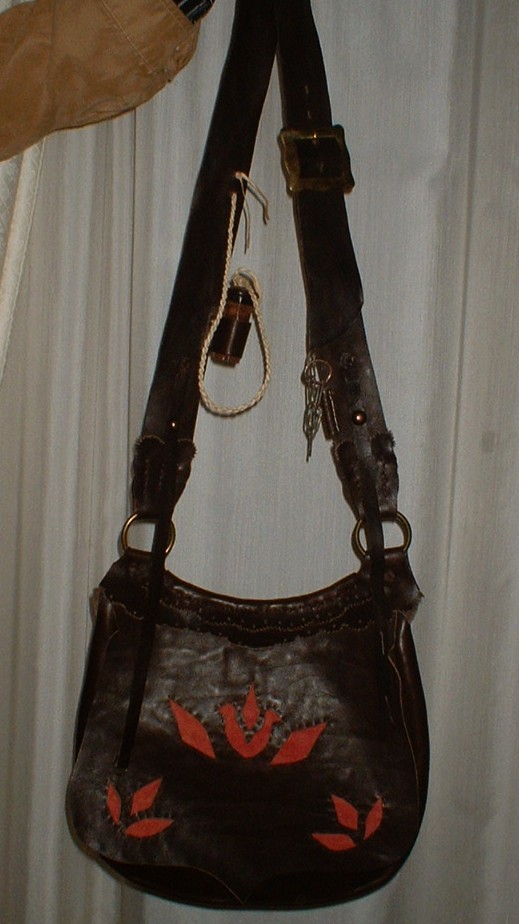
Ecco un altra borsa nello stile utilizzato sul finire del 700 negli States. Erano borse dette anche "German bags" perchè la loro origine era in Germania o " Puzzle bags" perchè costruite assemblando diversi strati di pellami.
Questa in particolare ha le due cinghie a cui andava appeso il corno per la polvere da sparo nonchè un dosatore per la stessa polvere ed un attrezzo in ferro forgiato per la pulizia del punto in cui avveniva l'innesco nel fucile. Il tutto era fissato alla tracolla della borsa per poter ricaricare più velocemente il fucile ad avancarica.

-------------------------------------

Here's another bag in a style common at the end of the 700 in the States. These bags were also called "German bags" 'cause their origin was in Germany or "Puzzle bags" because they were built by assembling several layers of leather.
This particular one has two straps to hang on the gunpowder horn as well a powder measure and an iron forged a tool to clean the seat of the flint on the muzzle-loading rifle . Everything was fixed to the strap of the bag to re load faster.

martedì 18 ottobre 2011

Il Gioco degli Angeli


Fra il '700 e l'800, quando la popolazione iniziò a crescere nel numero e gli insediamenti a svilupparsi, gli emigranti inglesi e tedeschi portarono sulle nuove colonie americane quelle che erano le tradizioni artigianali già presenti nei rispettivi paesi di origine. Fra queste l'arte e gli stili della lavorazione delle borse in cuoio destinate alla caccia. Questa mia borsa riprende un originale creato da un grande artista americano sullo stile di quelle usate sul finire del '700 sui nuovi territori americani. Il nome della borsa è: Angels Game.

Un grazie speciale va ai miei due modelli di eccezione: Josey e Cappy!

------------------------------------

Between '700 and '800, when the population began to grow in number and the settlements to develop, the British and German immigrants brought in the new American colonies the craft traditions they already had in their countries. Among these styles of art and workmanship there were the so called hunting bags or pouches. This my bag is made starting from an original one made by a great American artist in the style of those used at the end of '700 on the new American territories. Its named: Angels Game.

A special thanks goes to my two very special models: Josey and Cappy!

venerdì 7 ottobre 2011

Ancora foderi...


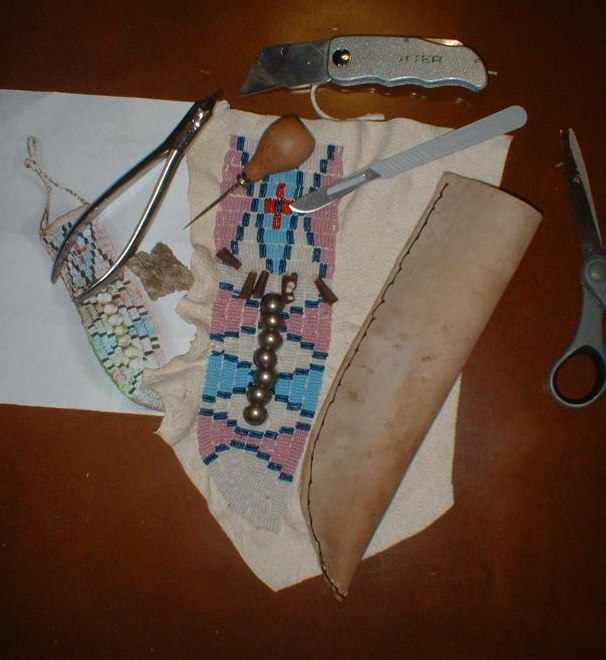
Alcune fasi nella realizzazione della replica di un fodero originale. L'interno è in cuoio mentre l'esterno, decorato a perline, è in pelle a concia Indiana. All'inizio della pagina alcuni foderi realizzati da Angela Swedberg.
-----------------------

Some steps in the making of a knife sheat replica. The case inside is made with raw hide while the beaded case is made with brain tanned hide. At the top of the page some knife sheaths made ​​by Angela Swedberg


mercoledì 24 agosto 2011

Coltelli Indiani

 Dagger Sheat

Una serie di coltelli e foderi realizzati secondo le tecniche proprie degli Indiani d' America.
Alcuni sono originali mentre altri sono repliche o prodotti originali di altissima qualità che è possibile vedere (ed eventualmente acquistare direttamente dagli artisti) su questo sito: 
http://contemporarymakers.blogspot.com/
----------------------------------

A series of knives and blades made according to the Native People techniques. Some are original while others are replicas or originals of the highest quality. You can see these and other knives (and purchase them directly from the artists) on this site:
http://contemporarymakers.blogspot.com/


mercoledì 3 agosto 2011

Iniskim, la Roccia che Chiamò il Bisonte


Una tradizione Blackfoot: 

"Anche se la nostra gente aveva iniziato a vivere nel modo in cui i Makoyi (i lupi) ci avevano mostrato, la vita era ancora molto dura ed il popolo soffriva spesso la fame. Un giorno Iinii (il Bisonte) ebbe pietà della nostra gente.  Fu così che una donna chiamata Donnola, mente stava raccogliendo l'acqua da un fiume vicino il campo,  sentì qualcosa chiamarla dai cespugli. Guardando meglio scoprì che a parlarle era una pietra. La pietra le spiegò come essa stessa potesse essere usata in una cerimonia che avrebbe attirato i bisonti verso un pisskan (dirupo dal quale erano fatti cadere giù). Donnola prese Iniskim, la Pietra che Chiama il Bisonte, e la portò al campo. La donna raccontò ai leaders spirituali della cerimonia per chiamare i bisonti. Il popolo seguì le sue istruzioni e presto ebbe una grande quantità di carne per nutrirsi e nuove pelli per le sue tende. Ci sono molti Iniskim nella Prateria. Molte persone li conservano ancora in involucri sacri. Noi invochiamo l'Iniskim perchè ci aiuti ad avere successo nella vita".

L'Iniskim è una pietra fossile (Ammolite) la cui forma ricorda un bisonte.

------------------------------

 "Although our people began to live as Makoyi (wolves) had shown them, life was still very hard and the people were often hungry. One day Iinii (buffalo) took pity on our people.  A lady named Weasel Woman was collecting water from a river near her camp when she heard something calling to her from the bushes. When she looked closer, she found a stone that spoke to her. The stone explained how it could be used in a ceremony that would call the buffalo towards a pisskan (buffalo jump). Weasel Woman took the Iniskim, the buffalo calling stone, back to camp. She told the spiritual leaders about the ceremony to call the buffalo. The people followed her instructions and soon they had plenty of meat and many hides for new lodge covers.  There are numerous Iniskim on the prairies. Many people still keep them as sacred bundles. We call on iniskim to help us have successful lives".

The Iniskim is a fossil stone (Ammolite) whose shape resembles a buffalo.

Una borsa da me realizzata per la mia Iniskim

a bag I made for my Iniskim, a gift from a very dear friend


sabato 23 luglio 2011

La Memoria Al Petto

Amuleto proveniente dalle Pianure del Nord

forma "a diamante"

Un mio amuleto "a diamante" . E' realizzato con pelle a concia Indiana, ermellino, perline seme di inizio '900, perle "Prosser" e in ottone. Ho realizzato il motivo al centro pensando ad una amica.

--------------------

A fetish I made in a "diamond" shape. It's made with brain tanned hide, ermine strips, old seed beads, "Prosser" beads and brass beads. I had a friend in mind when I made it.


domenica 17 luglio 2011

Buffalo Pouch


"Buffalo Hunt on the Southwestern Prairies', 

olio su tela, John Mix Stanley, 1845

Una borsa da me realizzata. I suoi decori rappresentano gli zoccoli e le tracce lasciate dal bisonte.

-----------------------------------

A pouch just finished. It's made out from brain tanning deer hide. It has buffalo hooves and tracks  beaded on it.